Network Resilience & Efficiency
Network analysis of Madrid's Metro network to assess resilience under targeted station/edge disruptions.
Problem Definition
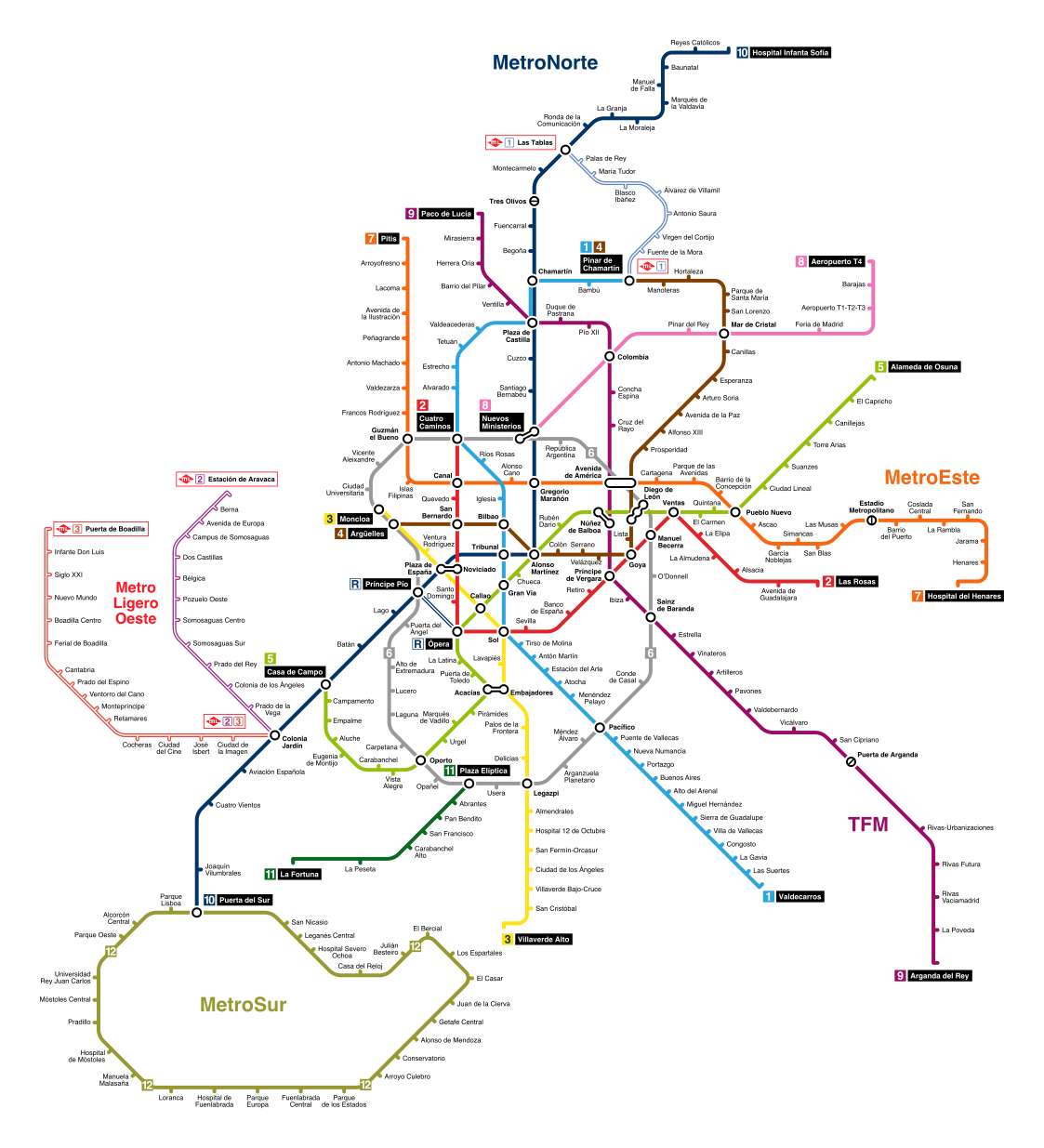
We study the Madrid Metro as a directed and weighted graph to evaluate resilience and efficiency under disruptions. Stations are nodes; connections carry weights reflecting travel time and transfer penalties, yielding realistic shortest paths. We propose the following research question: Which stations/edges are most critical, and how do targeted failures affect Global Network Efficiency (GNE) and the Largest Connected Component (LCC)?
Methodology
We construct two complementary network models: (1) a line-connectivity graph measuring redundancy via multi-line links, and (2) a travel-time + transfer graph where intra-station transfer edges and inter-station run times define path costs.
We compute strength, betweenness and closeness centralities.
-
Strength of node i \(s_i=\sum_j w_{ij}\)
-
Betweenness of node i \(C_B(i)=\sum_{s\ne i\ne t}\frac{\sigma_{st}(i)}{\sigma_{st}}\) where \(\sigma_{st}\) is the number of shortest paths from s to t and \(\sigma_{st}(i)\) is those passing through i.
-
Closeness of node i \(C_C(i)=\frac{n-1}{\sum_{j\ne i}d(i,j)}\)
Furthermore, we detect communities with Louvain algorithm and run the following attack simulations: single-node removals, sequential removals with dynamic re-ranking, and edge slowdowns targeting inter-cluster and high-centrality links. \(Q=\frac{1}{2m}\sum_{i,j}\Big(A_{ij}-\frac{k_i k_j}{2m}\Big)\,\delta(c_i,c_j)\) with total weight \(2m=\sum_{i}k_i,\;k_i=\sum_jA_{ij}\) and community labels \(c_i\).
The Metrics tracked for assesment are Global Network Efficiency (GNE) and the Largest Connected Component (LCC).
-
Global Network Efficiency (GNE): \(\mathrm{GNE}(G)=\frac{1}{n(n-1)}\sum_{i\ne j}\frac{1}{d(i,j)}\) with \(d(i,j)=\infty\) contributing 0.
-
Largest Connected Component (LCC): \(\mathrm{LCC}(G)=\max_{C\in\mathcal{C}(G)}|C|\) where \(\mathcal{C}(G)\) are connected components.
Results
Removing individual stations exposes where the network is most fragile. Stations with high betweenness centrality produce the largest drops in both efficiency and connectivity when removed in isolation. In contrast, high-strength hubs mostly increase average path lengths (slower trips) but fragment the network less. This indicates that “bridge” stations dominate resilience outcomes more than raw local connectivity.
Under sequential removals with dynamic re-ranking, targeted strategies accelerate damage dramatically. Betweenness-guided attacks degrade the system the fastest.


Edge-level disruptions confirm the importance of inter-community ties and links incident to central nodes. Slowing high-centrality edges (by increasing effective travel times) produces the largest efficiency loss, closely followed by inter-cluster edges identified via Louvain communities. Random slowdowns are clearly less harmful. The community structure helps localize these bottlenecks.

Taken together, the results suggest resilience efforts should prioritize intermediary stations (bridge nodes) and the inter-cluster corridors that connect regions of the network. While well-connected networks matter for delay propagation, the most consequential failures arise when a bridge station disappears or slows.